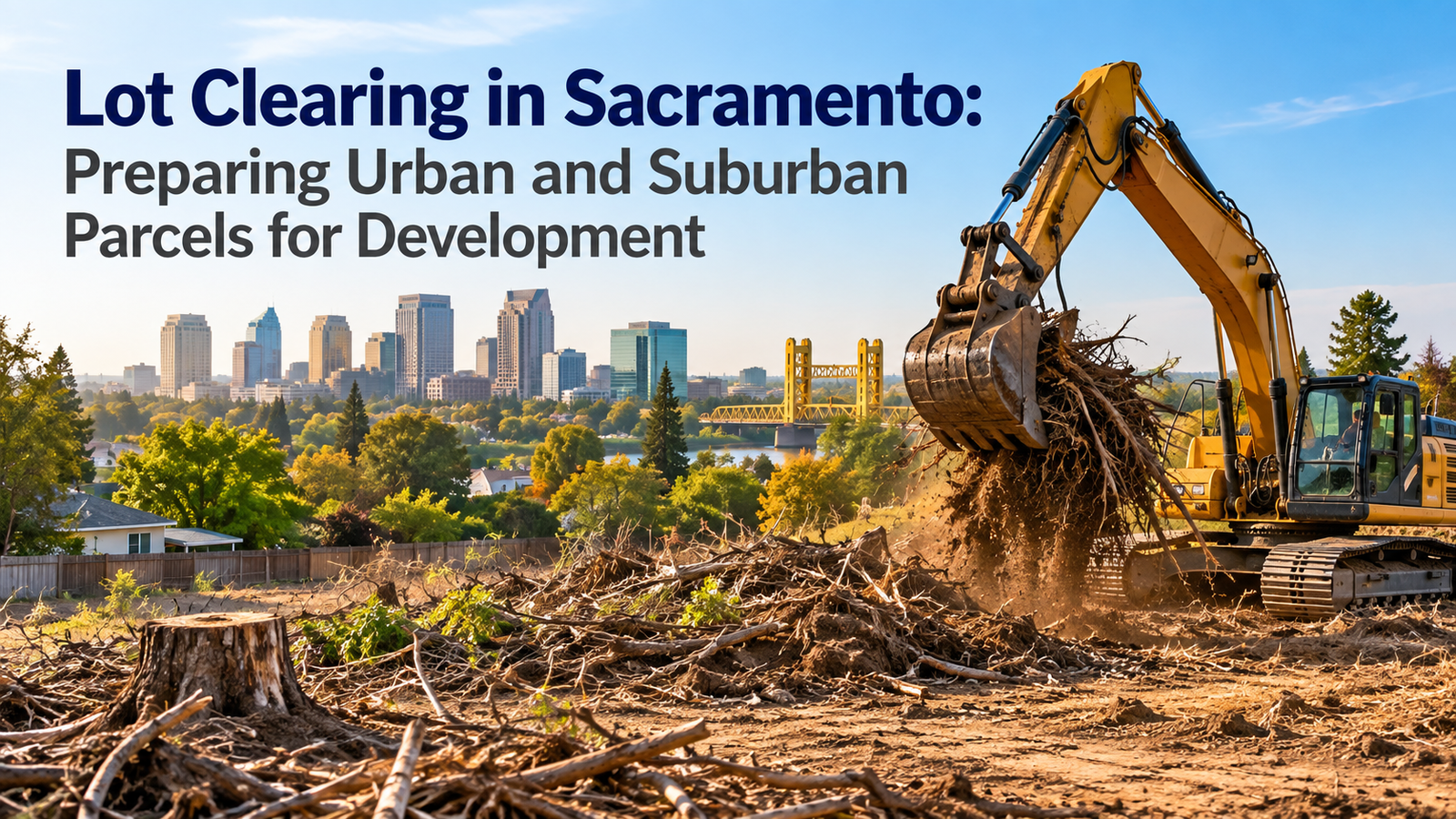
Lot clearing is the removal of all surface obstructions from an individual parcel to prepare it for construction, paving, landscaping, or another use. In Sacramento, lot clearing ranges from clearing a vacant residential infill lot in Midtown to preparing a multi-acre commercial parcel along the Highway 50 corridor for a new development. The work is fundamentally mechanical, but its execution in Sacramento is shaped by the valley’s soil conditions, California’s environmental regulations, and the specific characteristics of different types of parcels in the Sacramento urban and suburban environment.
This article covers what Lot Clearing Sacramento actually involves in Sacramento what types of parcels are cleared, what regulatory requirements apply, how the valley’s soil and vegetation create specific operational challenges, and how professional clearing contractors manage debris disposal in a region with comprehensive green waste and demolition debris recycling programs.
Types of Lots Cleared in the Sacramento Region
Vacant urban infill lots in established Sacramento neighborhoods may be overgrown with invasive vegetation annual grasses, mustard, fennel, and ornamental escapees or may carry legacy structures, concrete foundations, underground utilities, and buried debris from previous uses. Clearing these lots requires not just vegetation removal but also demolition of legacy structures, removal of buried concrete and debris, and investigation of underground utilities before ground-disturbing work begins.
Vacant agricultural parcels in the Sacramento urban fringe the transition zone between the city’s edge and active farmland may have been out of production for years and carry mixed vegetation including annual grasslands, shrub encroachment from adjacent unmanaged areas, and scattered ornamental trees from former residences or agricultural uses. These parcels often have irrigation infrastructure pipes, valves, and headgates that must be removed or capped as part of the clearing process.
Commercial development parcels along Sacramento’s highway corridors Highway 50, Interstate 80, Watt Avenue, and similar commercial strips may be cleared of legacy commercial structures, parking lots, and their associated utility infrastructure as part of redevelopment. These clearings combine structure demolition with pavement removal, utility disconnection, and site preparation for new construction a scope that overlaps with demolition contracting as much as with traditional land clearing.
Invasive Species in Sacramento Lot Clearing
The Sacramento Valley has a significant invasive species problem. Annual grasses primarily yellow starthistle, medusahead rye, and wild oats dominate many disturbed parcels. Shrub invasives including Himalayan blackberry, tamarisk (saltcedar), tree-of-heaven (Ailanthus altissima), and giant reed (Arundo donax) establish aggressively on neglected parcels, particularly near waterways and drainage channels.
Lot clearing that simply removes above-ground vegetation without addressing the root systems and soil seed banks of invasive species sets up the cleared parcel for rapid recolonization. Himalayan blackberry regrows vigorously from root fragments; yellow starthistle produces tens of thousands of seeds per plant that remain viable in the soil for years; giant reed can regrow from stem sections that are spread by machinery during clearing. Professional lot clearing includes invasive species management as an integral component typically mechanical removal followed by herbicide treatment of regrowth timed to growth cycles.
The Sacramento-San Joaquin Delta and its tributary waterways impose additional constraints on clearing near invasive species in riparian zones. Giant reed and tamarisk removal near waterways is encouraged by water managers because these species consume significant water and displace native riparian vegetation, but their removal near regulated waterways requires CDFW Streambed Alteration Agreement review when the clearing is within the stream corridor.
Underground Hazards on Sacramento Infill Lots
Urban infill lot clearing in Sacramento frequently encounters underground hazards from previous uses. Buried oil storage tanks fuel oil tanks from pre-natural gas era residential heating, gasoline storage tanks from former service stations, and agricultural pesticide or fertilizer storage tanks are present on many older Sacramento parcels. Discovery of a buried tank during clearing creates an environmental liability regulated under the California Underground Storage Tank program administered by the State Water Resources Control Board.
Cesspools and septic systems from pre-sewer era construction are present under some Sacramento parcels. These underground structures can create void hazards for equipment if their covers collapse, and their contents must be properly decommissioned under Sacramento County Environmental Health requirements before the structure can be demolished and filled.
811 notification and utility marking is required before any ground-disturbing work on Sacramento lots. SoCalGas, SMUD, AT&T, Comcast, and other utilities mark their buried infrastructure through the California 811 notification system within two business days. Private utility locating services are used for utility laterals and private lines not covered by the 811 system.
Clearing Permits and Environmental Review in Sacramento
Lot clearing in Sacramento requires grading permits from the City or County when the work disturbs soil above the local ordinance thresholds typically 50 cubic yards in the city, with lower thresholds for hillside areas. The permit application requires a grading plan showing the proposed clearing area, a SWPPP for projects disturbing one acre or more, and an erosion control plan for smaller projects.
CEQA review may be required for clearing projects above defined thresholds or in areas with sensitive biological resources. Infill exemptions and categorical exemptions reduce the CEQA burden for many urban lots, but parcels with vegetation communities, potential special-status species habitat, or proximity to waterways may require an Initial Study to determine the appropriate level of environmental review.
SMAQMD dust control requirements apply to clearing projects in the Sacramento nonattainment area. Water trucks for soil moisture control, speed limits on unpaved access surfaces, and track-out prevention at site entrances are standard compliance measures. Smoke from vegetation burning is generally prohibited for urban and suburban clearing in Sacramento County, making green waste hauling and chipping the standard disposal method.
Debris Management in Sacramento Lot Clearing
Sacramento’s regional green waste and construction debris recycling infrastructure provides effective options for lot clearing debris. Vegetation can go to Sacramento County’s green waste composting facilities or to biomass energy processors. Clean concrete, brick, and asphalt can be recycled at local processors that produce recycled aggregate base material. Metal is sorted and taken to scrap dealers. Mixed construction debris goes to transfer stations that sort and process it before final disposal.
Sacramento maintains an active construction and demolition debris diversion program, and many commercial clearing projects document recycling rates as part of LEED certification processes or in compliance with Sacramento’s Zero Waste goals. Contractors who sort material on site achieve better recycling rates and lower overall disposal costs, because clean material streams command lower tipping fees than mixed debris loads.
Frequently Asked Questions: Lot Clearing in Sacramento
What underground hazards should be assessed before clearing a Sacramento infill lot?
Buried oil storage tanks, cesspools and septic systems, and uncharted utility lines. 811 notification marks public utility lines; private locating services find private laterals. Environmental Phase I assessments identify likely underground storage tank locations on properties with commercial history.
How are invasive species managed in Sacramento lot clearing?
Mechanical removal followed by herbicide treatment of regrowth, timed to the growth cycles of target species. Simply clearing without treating invasives leads to rapid recolonization, particularly from Himalayan blackberry and yellow starthistle.
What permits are needed for lot clearing in Sacramento?
Grading permits from the City or County, SWPPP coverage for disturbances over one acre, SMAQMD compliance for dust control, and CEQA review if the lot has biological sensitivity or special-status species habitat.
Can vegetation from lot clearing be burned in Sacramento?
Generally no. Urban and suburban burning is restricted by SMAQMD. Green waste goes to composting or biomass facilities; chipping material on site for mulch is an alternative to hauling.
What is the 811 notification system and why is it required?
California’s statewide utility notification system requires notice to utilities two business days before ground-disturbing work. Utilities mark their buried infrastructure within that window. Failure to notify before excavation risks damaging utility lines and creates legal liability.
Lot clearing in Sacramento is a regulated activity with both environmental and operational dimensions specific to the Central Valley. Professional clearing contractors in the region manage invasive species effectively, comply with SMAQMD and SWPPP requirements, investigate underground hazards before work begins, and dispose of debris through Sacramento’s well-developed recycling infrastructure.